Client snapshot
Client
Direct-to-consumer eCommerce brand
Sector
eCommerce / Spirits
Region
APAC
Company size
Founding team < 10
Timeline
5 weeks build
Service
Custom Software + Agentic Admin
Stack
The challenge
The brand was launching into a competitive category with a lean team and no patience for fragmented SaaS. Off-the-shelf platforms forced them into rigid templates, generic SEO and manual content workflows that would have required a full agency on retainer to operate. The founders wanted the opposite — a custom storefront they fully controlled, native payments, and an AI-first operating model where content, SEO and admin ran themselves. The goal was to publish at agency scale with a founding team of fewer than ten, and to keep all customer and revenue data in their own environment.
The solution
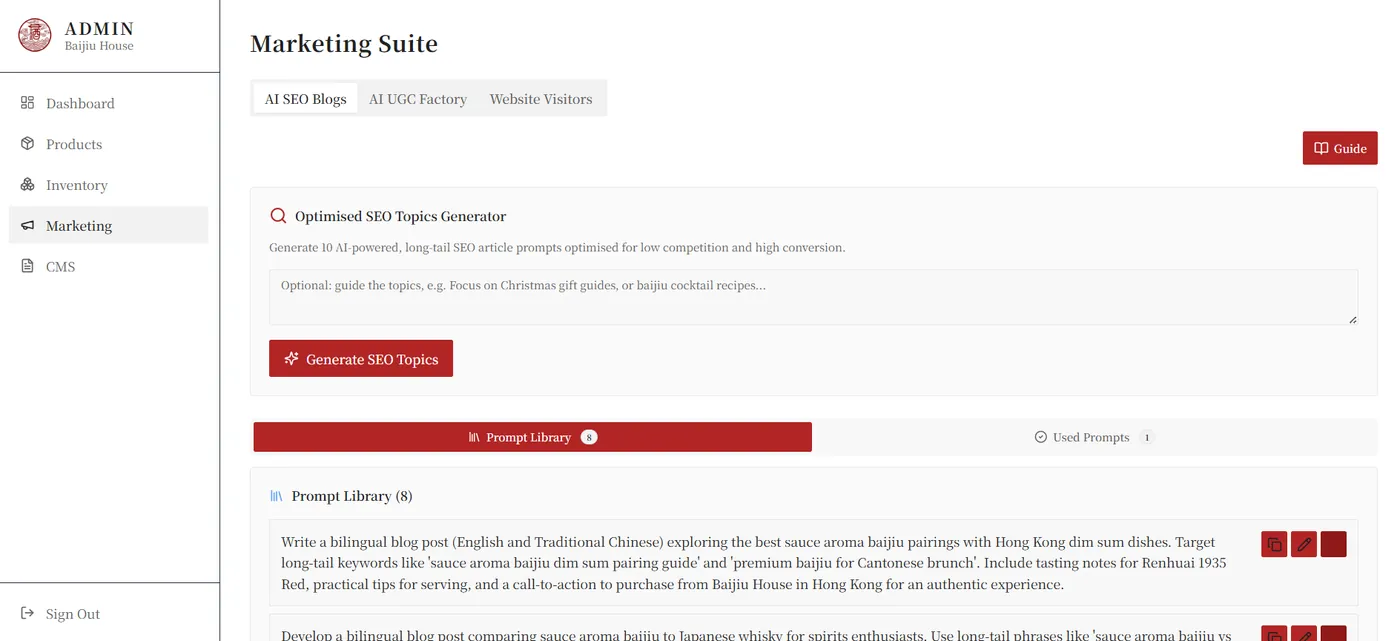
We built the entire stack custom. The storefront is a bespoke React commerce experience with native payment integration, optimized for the brand's catalog and storytelling rather than a generic template. On top of it we deployed three AI engines. The AI UGC content farm generates on-brand product imagery, lifestyle content and short-form video scripts continuously, ready for review and scheduling. The AI SEO engine plans the editorial calendar, drafts articles grounded in keyword data, monitors rankings and surfaces opportunities the team can act on the same day. The agentic admin orchestrates the rest — order operations, customer service triage, inventory alerts, marketing send-outs, weekly performance briefings — running autonomously and escalating only what needs a human decision. Everything is owned by the brand: source code, prompts, data, deployment. The founders run an operation that looks like a 30-person team on a fraction of the headcount, and every output is auditable and on-brand because the system is theirs end to end.
Before
- Generic SaaS storefront and templates
- Manual content production at agency pricing
- Reactive, ungrounded SEO
- Founders bottlenecked on admin and ops
After
- Custom storefront with native payments
- AI UGC farm: 10× content output, on-brand
- AI SEO engine drafting and monitoring continuously
- Agentic admin running ops autonomously
Results
content output vs. manual workflow
reduction in operational time
autonomous admin workflow
build to first production release
"We run like a team three times our size. The content farm, the SEO engine and the agentic admin do the work — we make the decisions that actually need a human."
Tech stack & integrations
Want results like this for your team?
Book a free 45-minute scoping call. We'll map your highest-leverage SOP and tell you honestly whether AI is the right tool.
See all case studies