Client snapshot
Client
Hong Kong real estate investment firm
Sector
Real Estate Investment Management
Region
Hong Kong
Company size
20–50 person team
Timeline
4 weeks to first production release
Service
AI-First Investment Management Suite
Stack
The challenge
The investment team was stretched thin. Senior analysts and associates were spending the bulk of their week on tasks that had nothing to do with investment decisions: answering the same client questions on WhatsApp, chasing documents, sending marketing updates, copying lead data between tools and assembling weekly reports by hand. WhatsApp was the dominant channel for client communication, but every inbound message landed in a personal mobile inbox — no audit trail, no shared CRM context, no after-hours coverage. As the client base grew, response times slipped and high-value enquiries got buried under routine ones. The firm wanted to keep WhatsApp as the front door, but route the work through a system that could handle the routine 75% automatically and surface only the conversations that genuinely needed a partner's attention.
The solution
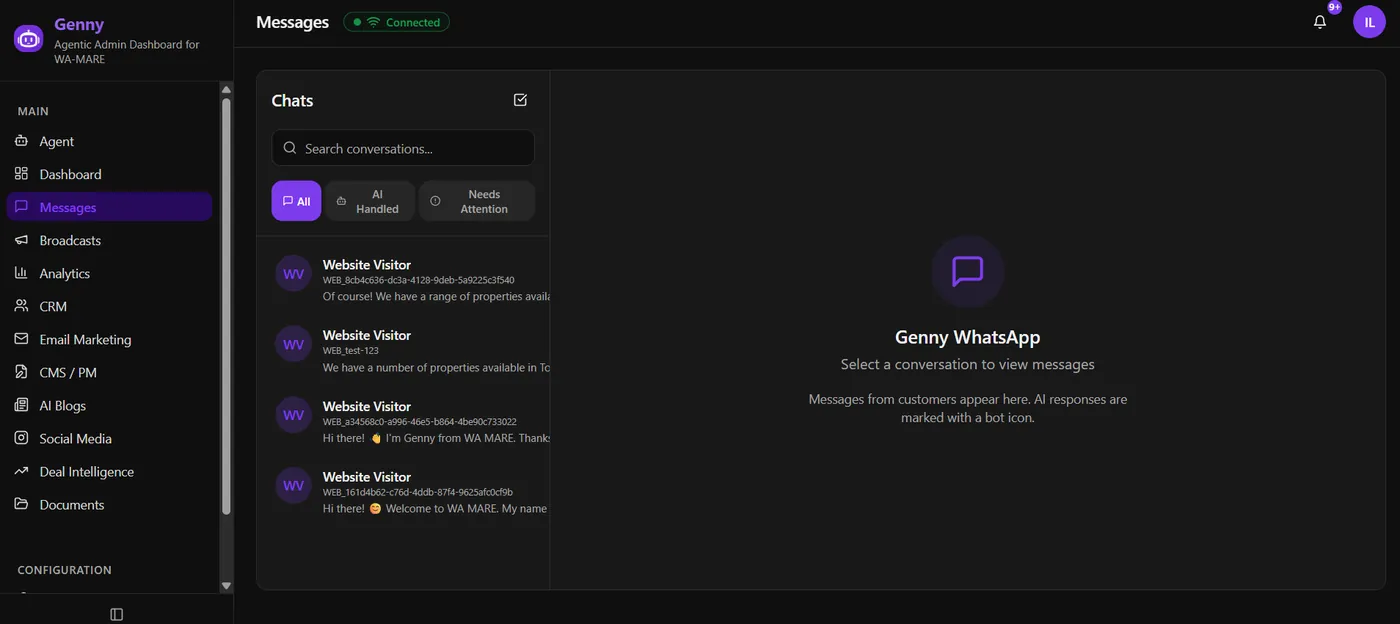
We built an AI-first investment management suite with Genny as the WhatsApp-facing agent. Every inbound message is matched against the firm's CRM and document store, so Genny replies with the right context — fund updates, portfolio performance, document requests, meeting scheduling — and creates or updates the CRM record automatically. Genny is tool-calling, not a static chatbot: it can pull live portfolio data, look up investor records, draft follow-ups, attach the right tearsheet, and book meetings into the team's calendar. Anything outside its confidence band is escalated to the assigned associate with a full conversation summary, so handoffs take seconds instead of minutes. On top of the agent we layered marketing automation (segmented investor updates), a sales-ops workflow (lead capture → enrichment → assignment), and an analytics dashboard that gives partners a live view of pipeline, response times and client sentiment. The entire stack runs on infrastructure the firm controls, with PDPO-compliant logging and role-based access, so sensitive investor communications never leave their environment.
Before
- WhatsApp messages in personal phones — no audit trail
- Senior team answering routine client questions
- Lead data copy-pasted between tools
- Weekly reports assembled manually
After
- Genny handles 75% of WhatsApp servicing autonomously
- CRM updated in real time from every conversation
- Marketing and sales ops triggered on lead activity
- Live analytics dashboard for partners
Results
reduction in manual servicing tasks
faster client response time
of routine operations automated
of conversations logged & auditable
"Our analysts finally spend their time on deals. The agent handles the routine and only escalates what actually needs us — that alone has been transformational."
Tech stack & integrations
Want results like this for your team?
Book a free 45-minute scoping call. We'll map your highest-leverage SOP and tell you honestly whether AI is the right tool.
See all case studies