Client snapshot
Client
Multi-boutique luxury retail group
Sector
Luxury Retail
Region
APAC
Company size
Hundreds of sales associates across boutiques
Timeline
3 weeks build
Service
Custom Software + AI Client Memory
Stack
The challenge
In luxury retail, the relationship is the product. A returning VIP expects the associate in front of them to remember what they bought last season, what their partner prefers, which boutique they were last served in, and what conversation was left open. In practice, that memory lived in the heads of individual associates. When a client walked into a different boutique — or their usual associate was off — the experience reset to generic. The group's POS and CRM held the raw data, but no associate had time to dig through transaction history mid-conversation. The result was inconsistent service, missed cross-sell moments and slow erosion of VIP loyalty in a category where switching costs are emotional, not financial. The brief was clear: give every associate, on every floor, the memory the brand was supposed to have.
The solution
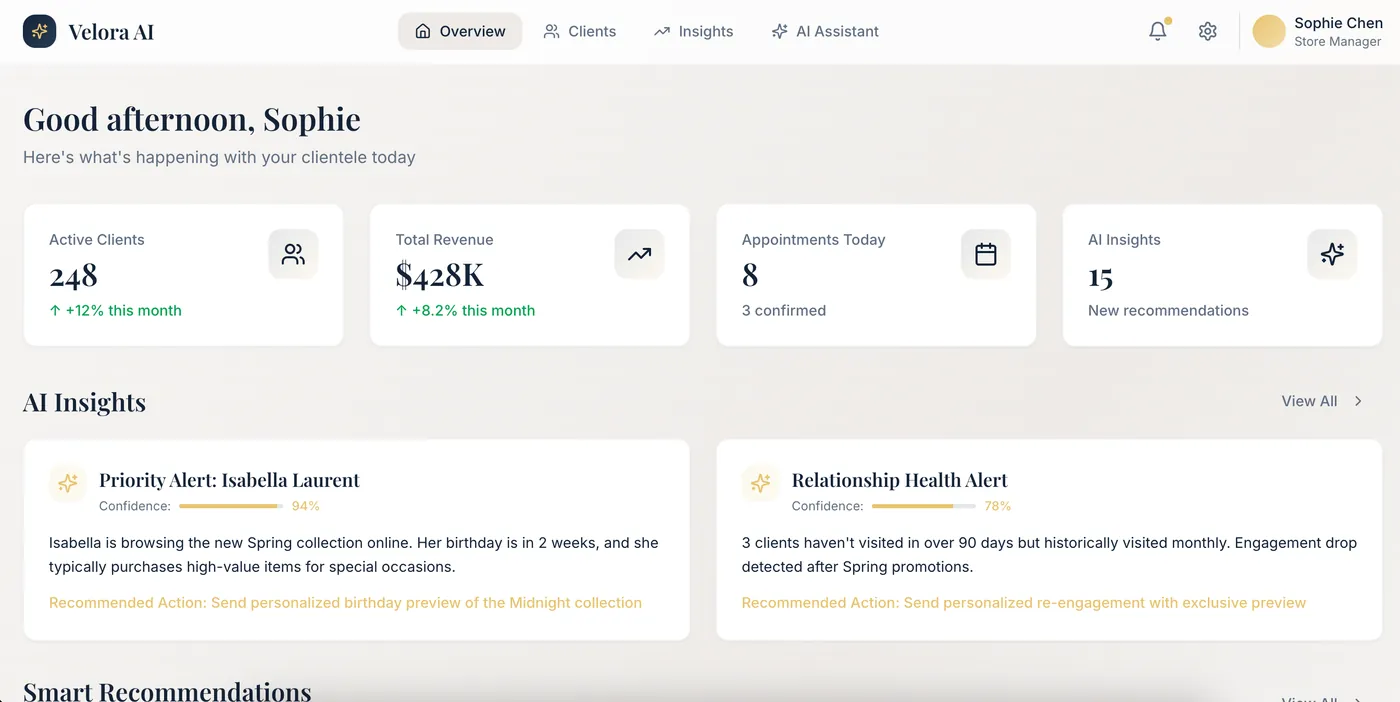
We built an AI client-memory system that sits on top of the existing POS and CRM. When an associate scans or looks up a client, the system surfaces a structured profile in seconds: purchase history, preferred categories and sizes, sensitivity flags (allergies, gifting partners), open service items, and an AI-generated set of personalized talking points for this specific visit. The memory is shared across boutiques. A client served in Hong Kong last month walks into Singapore today and the associate sees the same context. The AI continuously updates the profile from every transaction and every logged interaction, and pushes proactive notifications when a high-priority VIP enters the store. We paid close attention to associate UX. The interface is glanceable on a tablet, designed to read in 5 seconds between client interactions, and never asks an associate to type during a conversation. Staff adoption — usually the hardest part of luxury retail tech — landed at 92% within the first month because the tool genuinely made their job easier, not heavier.
Before
- VIP context locked in individual associates
- Generic service across boutiques
- Missed cross-sell and gifting moments
- POS / CRM data unused in the moment
After
- Unified client profile, every boutique
- AI-generated talking points before every interaction
- Real-time alerts when VIPs walk in
- Personalized recommendations driving AOV
Results
increase in VIP client retention
higher average transaction value
sales-associate adoption rate
improvement in personalized service scores
"Our associates feel like the brand finally has a memory. A VIP can walk into any boutique in the region and be recognized — not just at the door, but in the conversation."
Tech stack & integrations
Want results like this for your team?
Book a free 45-minute scoping call. We'll map your highest-leverage SOP and tell you honestly whether AI is the right tool.
See all case studies