Client snapshot
Client
Carpark operator (Hong Kong)
Sector
Car Parking / Real Estate
Region
Hong Kong
Company size
Operations team < 30
Timeline
3 weeks build
Service
Custom Software + AI Analytics
Stack
The challenge
The operator had the data but no insight. Sensors and payment systems generated thousands of events per day, yet decisions about pricing, staffing and capacity were still made off gut feel and end-of-month exports. Managers wanted to know which sites were under-priced at peak hours, which days were quiet enough to pull back hourly staff, and how a public holiday would shift demand. Building these reports manually took analysts a week each and they were stale by the time they landed. The team needed an agent that could answer "what is happening, and what should we do about it" without waiting for a report to be commissioned.
The solution
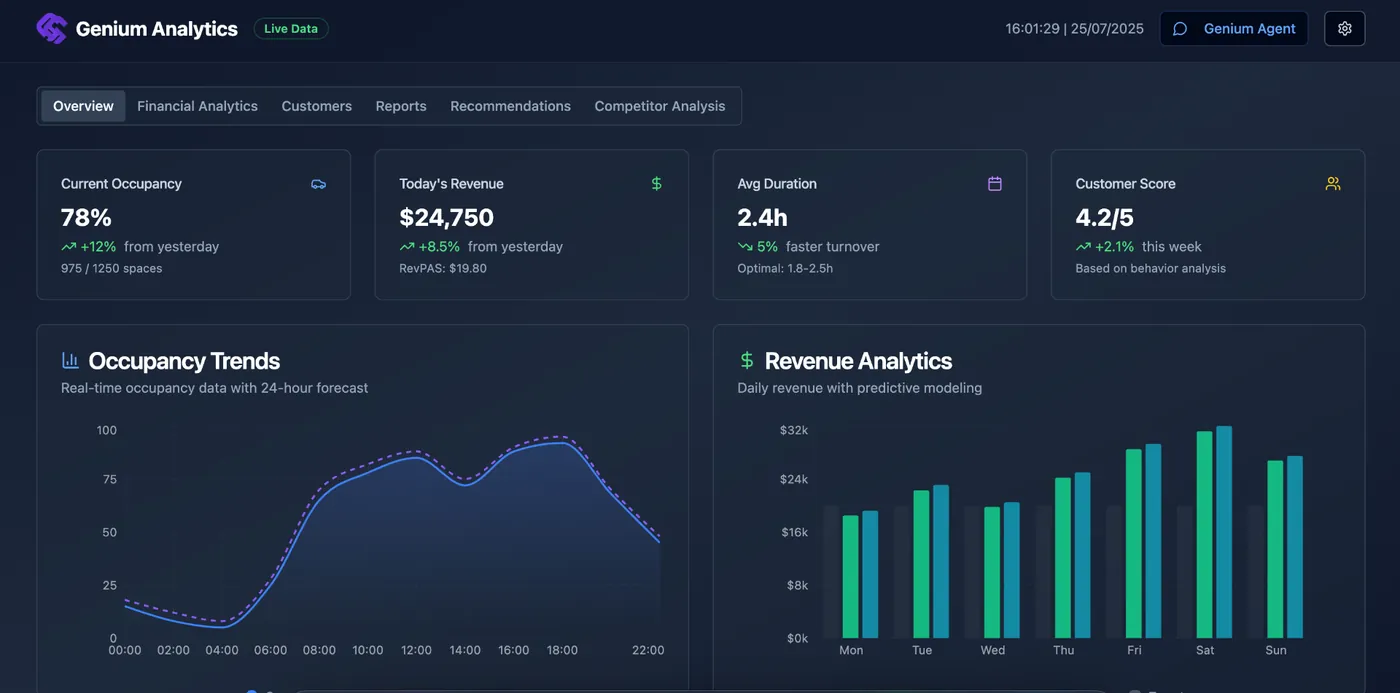
We built an AI analytics agent on top of the existing parking sensors and payment system. It continuously ingests occupancy, dwell-time and transaction data, builds a baseline per site and per hour, and flags anomalies in real time. Managers can ask natural-language questions — "compare yesterday's evening peak across all sites", "show me where we left revenue on the table this week", "forecast next Saturday given the typhoon signal" — and get a chart-backed answer in seconds. The agent also generates scheduled reports automatically and pushes pricing recommendations into the admin system, with every recommendation linked back to the data that justified it. Forecasting uses both historical seasonality and live signals (events, weather, hardware downtime) so demand predictions hold up against real-world disruption. Because the agent is grounded in the operator's own data and never leaves their environment, sensitive revenue numbers never sit on a third-party SaaS dashboard.
Before
- Static end-of-month spreadsheet reports
- Pricing and staffing decisions on gut feel
- No live anomaly detection on revenue
- Bespoke analysis took analysts a week
After
- Live AI analytics agent across every site
- Natural-language queries, chart-backed answers
- Pricing recommendations grounded in data
- Demand forecasts that hold up under disruption
Results
increase in revenue optimization
better demand forecasting accuracy
improvement in operational efficiency
live insight across every site
"We stopped commissioning reports. The agent already knows the answer — and tells us what to do about it before the shift even starts."
Tech stack & integrations
Want results like this for your team?
Book a free 45-minute scoping call. We'll map your highest-leverage SOP and tell you honestly whether AI is the right tool.
See all case studies