Client snapshot
Client
Real estate investment team
Sector
Real Estate Investment
Region
APAC
Company size
Investment team < 15
Timeline
4 weeks build
Service
Custom Software + AI Analytics
Stack
The challenge
Every new opportunity meant an analyst spending a week pulling comparable sales, modeling rental yield, normalizing data across listing sources and writing up a memo. Different analysts used different templates, different assumptions and different sources — so the partners could not actually compare two deals side by side without redoing the work. By the time a memo was ready, the better opportunities were already gone. The team wanted to keep human judgment at the center of investment decisions, but stop losing time to the mechanical first 90% of the research.
The solution
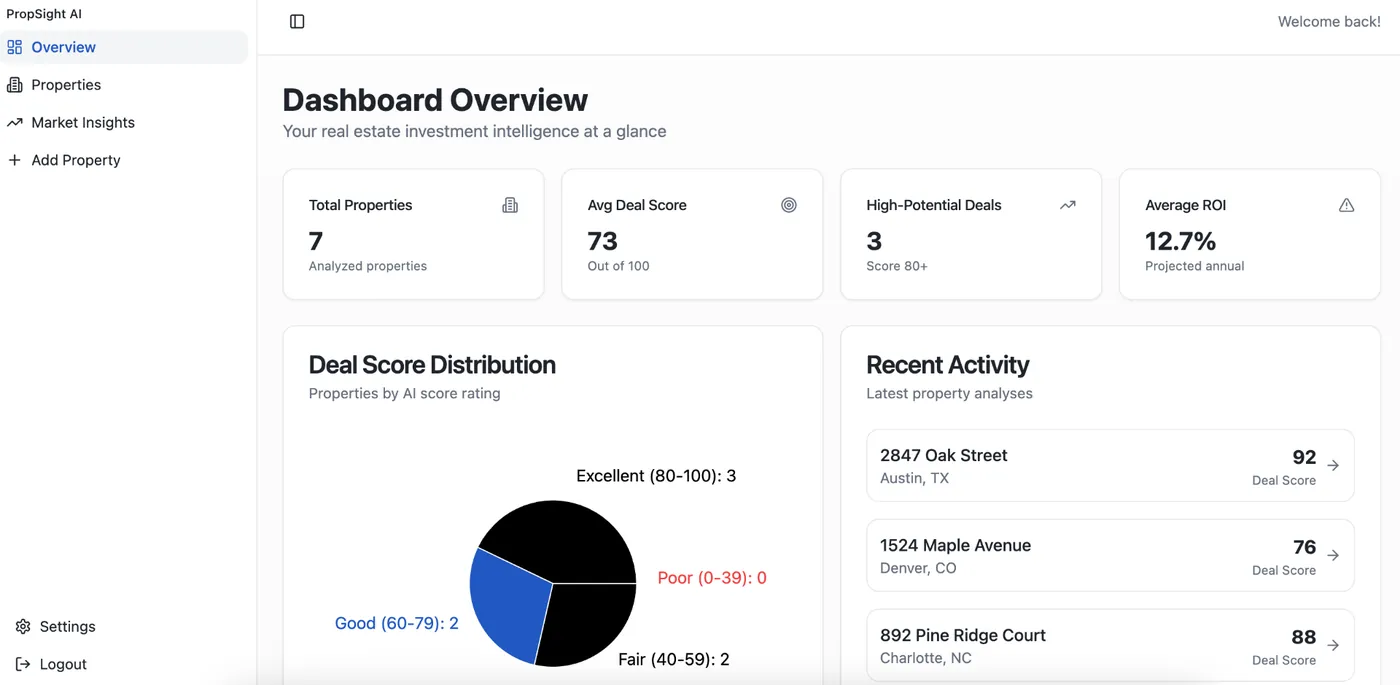
We built an AI deal intelligence platform that runs the mechanical first 90%. Paste a listing or upload a CSV and the platform pulls comparables, normalizes the data across sources, models predicted ROI and rental yield against historical sales, scores risk on liquidity, tenant profile and macro signals, and generates a standardized investment memo — all in seconds. Every memo follows the same template, references the same data sources, and exposes the assumptions behind each number. Analysts and partners can adjust assumptions live and watch the model update, so debate happens around the right numbers instead of around whose spreadsheet to trust. The platform also runs continuous market monitoring. The team gets alerts when a new listing hits their target criteria, when a comparable closes at a notable price, or when macro indicators shift the risk profile of an existing position. The agent never makes the final call — partners do — but it removes the bottleneck that used to gate every decision.
Before
- A week of analyst work per deal
- Inconsistent templates and assumptions
- Memos late, best opportunities lost
- No live market monitoring
After
- AI-generated memo in seconds, standardized format
- Live assumption-adjustable ROI and yield models
- Continuous alerts on listings, comps and macro shifts
- Partners spend time on judgment, not data prep
Results
reduction in research time per deal
improvement in investment accuracy
faster deal evaluation cycle
continuous market monitoring
"We finally argue about the right numbers instead of whose spreadsheet is correct. Every memo comes from the same model — and we look at three times as many deals."
Tech stack & integrations
Want results like this for your team?
Book a free 45-minute scoping call. We'll map your highest-leverage SOP and tell you honestly whether AI is the right tool.
See all case studies